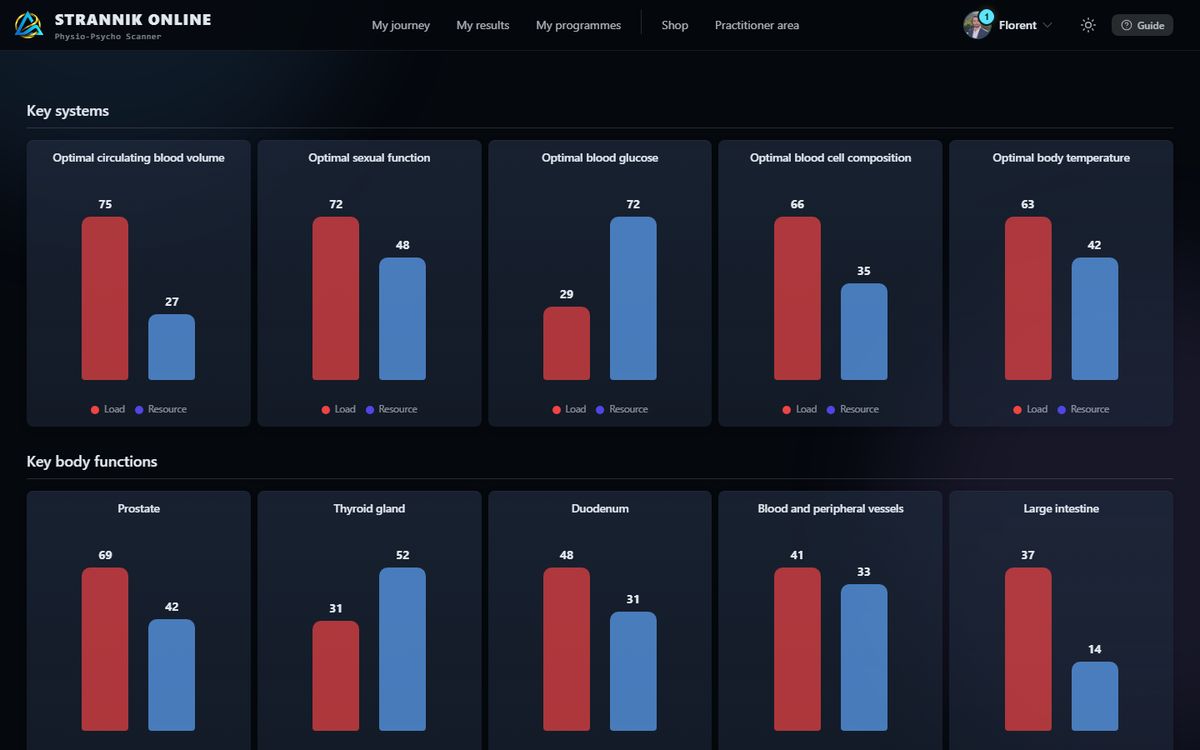
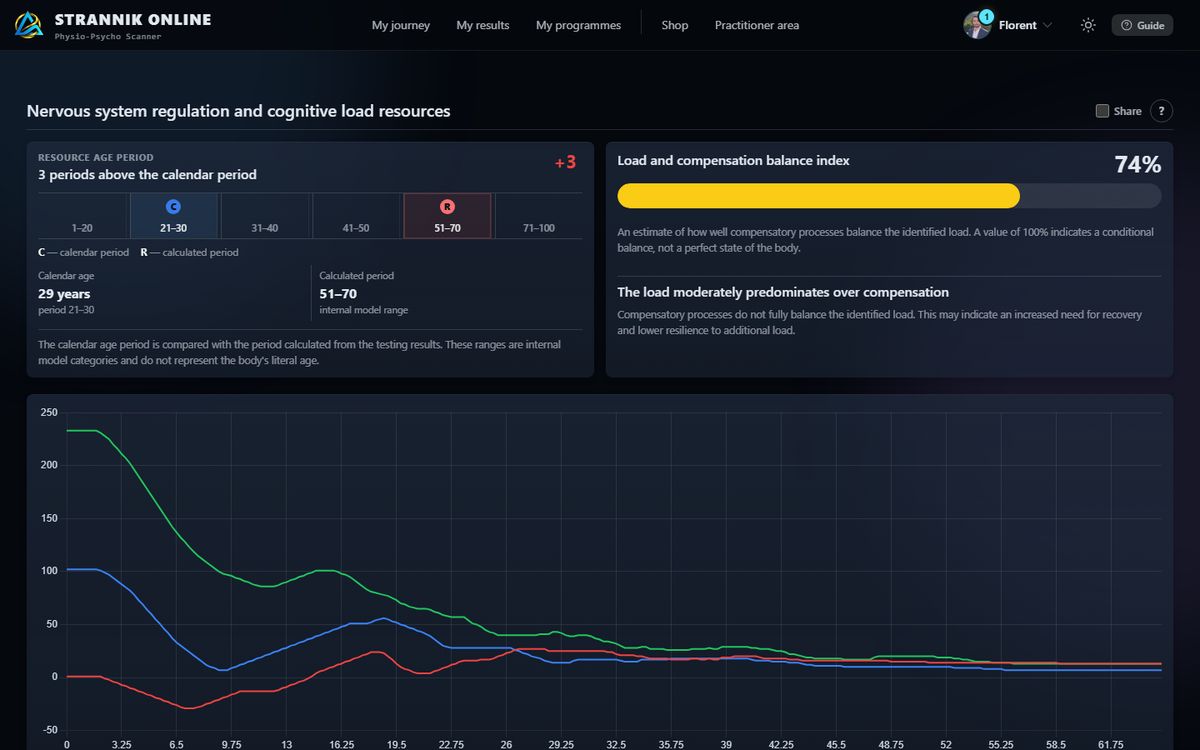
The recovery reserve and the capacities of the moment, from the most strained to the most available.
What you gain
Your practice gains in clarity, in flow and in precision
It is not the first appointment that changes, it is the way you work afterwards.Four effects, from first contact to follow-up.
You know where to start, and in what order
The ordering is already done when you open the file.You open the session where you would usually have arrived after an hour, and you keep that thread through every session that follows.
The client comes on board because they have seen
They no longer have to take your word for it: they are looking at their own map.Explaining becomes showing, and what you propose next speaks for itself.
They leave with something, and they come back
Advice sorted by direction and by horizon: what they start today, hold over the week, anchor over the month.Then a follow-up test that shows the shift.The session lasts until the next one.
You explain your choices without having to defend them
Every direction rests on something the client has in front of them.Your words gain precision, and the relationship gains trust.
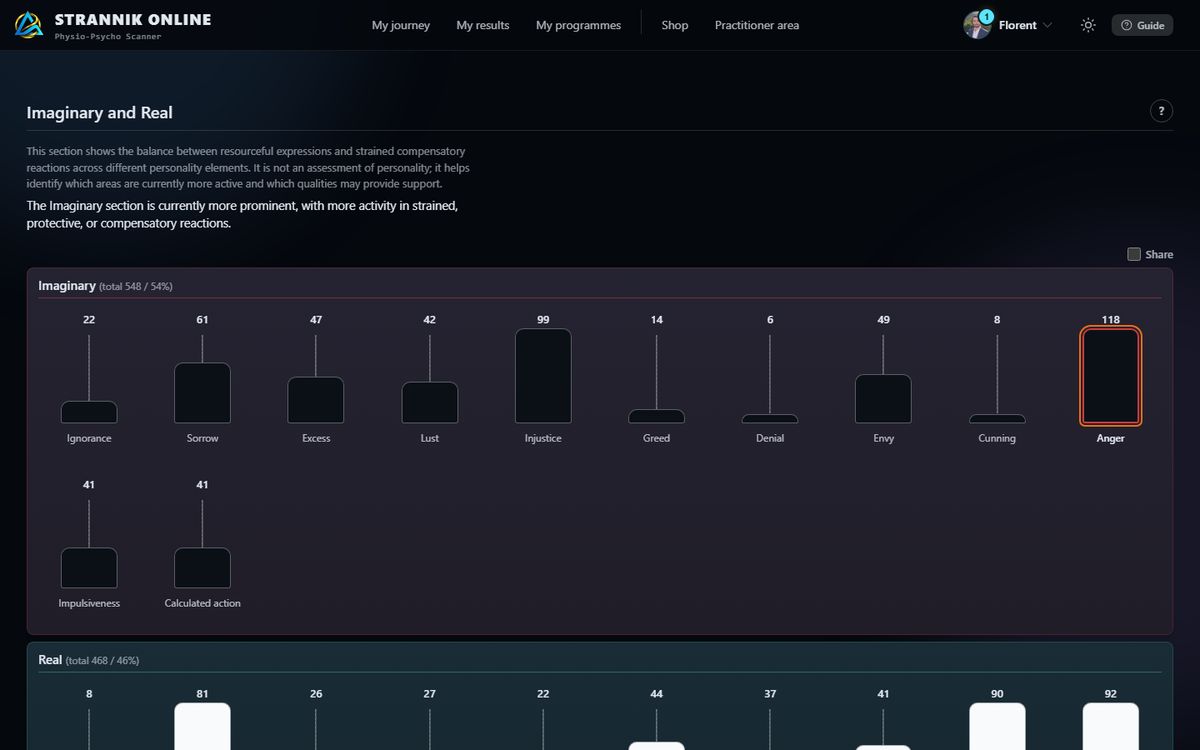
Real and Imaginary the part that leans on the resource, the part that compensates.
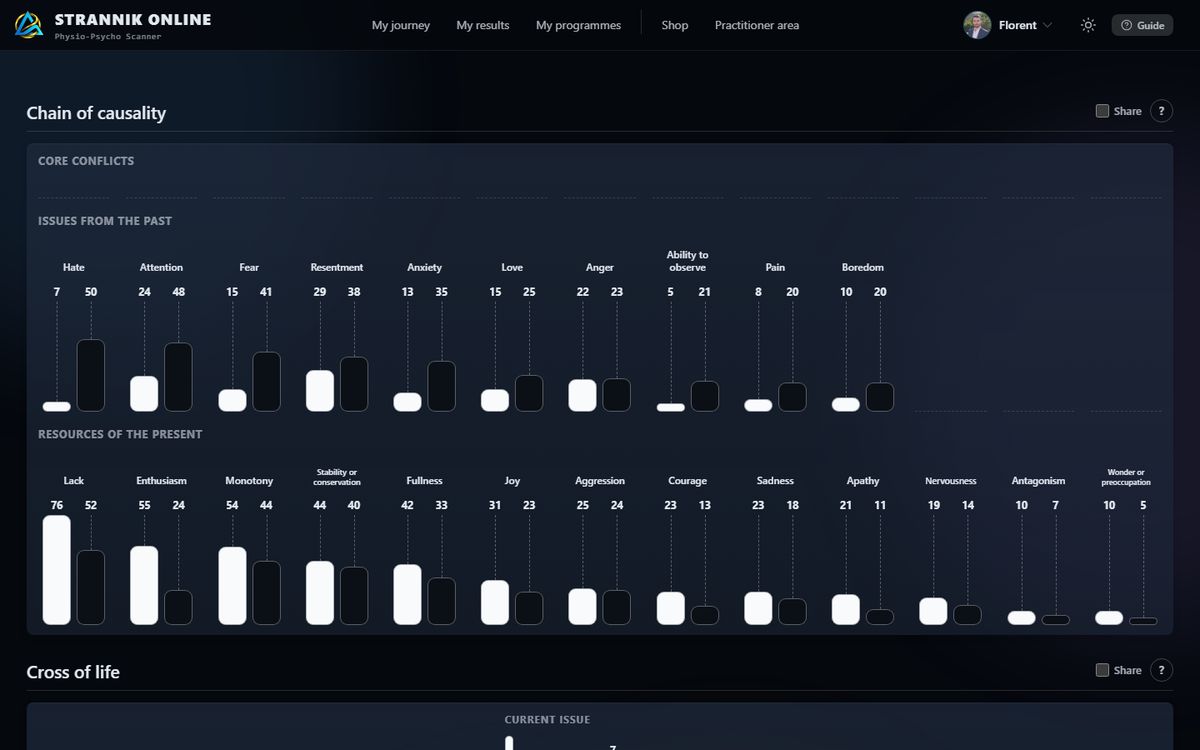
Stages of realisation how the resource spreads from intention to result.
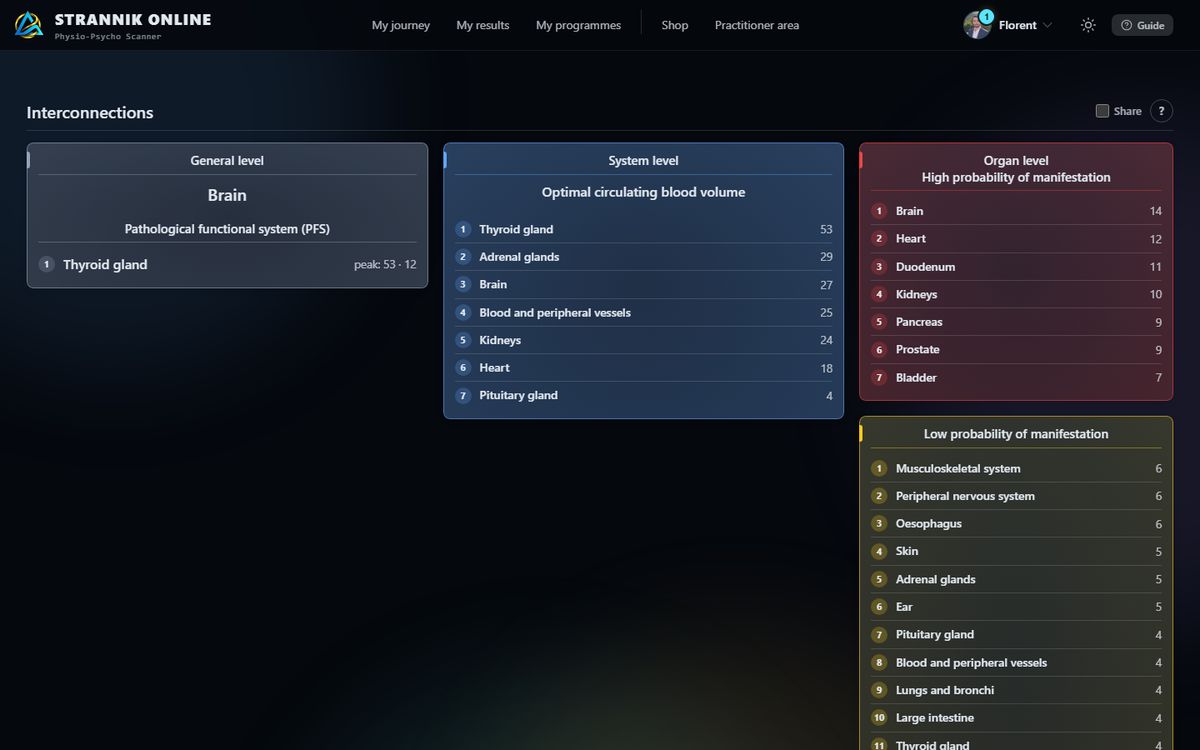
Body landmarks the 27 areas of the body associated with the state observed.
Load and resource 13 systems and 129 processes of regulation, recovery and adaptation.
Selection by request the data gathered for one of the 30 ready requests, the one the client brings.
The practitioner report50+ pages
What lies behind the synthesis: the detail organ by organ, the four balance matrices, enough to dig into an area or understand a link the session raised. You take from it what lights up the session, and choose what stays with the client, for as long as you decide.
Three views of the platform
01 · The viewerThe blocks of the result, and what you decide to leave with the client.02 · The client's pathFive stages, from the training test to the follow-up test.03 · The expert synthesisThe indicators gathered for the request brought.
The client does not see this screen.They see their own map, in words that need no explaining, and they leave with what you chose to leave them, for as long as you decide.
The Strannik makes no diagnosis and does not replace a health professional.It structures your reading, it does not do it for you.
What it rests on
The question we get first: is this serious?
It comes before everything else, and it is a fair one.Here is what stands behind the product, in four pieces, in the order you can check them.
01
The model is published
In Evidence-Based Complementary and Alternative Medicine, a peer-reviewed journal indexed in PubMed. DOI 10.1093/ecam/nel060.
02
The lineage is dated
A mathematical model developed from 1981 to 1997 by Dr Igor Grakov, based on named earlier work.Around eighty publications between 2003 and 2018.
03
The results converge
82% in 2002 on 370 patients, 85% in 2016 on 20, 87% in 2017 on 50.Three teams, three countries, three decades: the reading agrees with the diagnoses already known for those people.
04
And measured gains, not only agreement
Twenty volunteers, checked five times over their twenty sessions, by electroencephalography and cardiovascular testing: +33.7% contraction speed, +31.6% alpha rhythm, +30.4% relaxation speed, all at p < 0.001.
What we claim
✓The test asks the person nothing, and returns an ordered reading in fifteen minutes.
✓More than eight cases out of ten line up with diagnoses made elsewhere.
✓The neuro-regulation side has been tested in the laboratory, with figures and thresholds published.
What the test does, and what no questionnaire can copy: it asks nothing. Nothing to declare, so nothing to arrange: no desirability, no self-diagnosis, no effect of wording. It can be checked in fifteen minutes, and it is the one strong claim of the product that needs no regulatory permission.
What it is not
×A medical device, or a diagnosis.
×A substitute for care by a health professional.
×The explanation of a state by a single cause.
×A promise of results.
What it is
✓A functional analysis technology, resting on a precise theoretical model.
✓A ranked synthesis, to know where to begin.
✓A support for explaining clearly to the client what is at play.
✓A reading of human functioning, not an exhaustive report.
Strannik PPS
“Странник” means the traveller, the one who seeks the truth.
PPS for Physio-Psycho Scanner.
A dated origin, named authors, a continuity with no gap.That is what separates a technology from a method that appeared last year.
The technology continues the work of Dr Igor Grakov, physician and mathematician, who developed from 1981 to 1997 a biomathematical model representing cognitive processes as information-processing systems.
A second strand was developed between 2001 and 2005 on the basis of work in Emotional Dynamics by Dr Jean-Pierre Garitte and Dr Jimmy Eerebout, specialists in psychosomatics.
The Strannik is its application: an interface that carries the model towards individual analysis, then towards regulation work.
The protocol
An analysis grounded in perception
The Strannik asks no question about history or about feelings.It observes the way a person restores a colour that has been altered.It is a spectro-dynamic analysis: it reads a way of doing, not an answer.
The real test sequence, sped up.The veil that falls is the software's, and the six controls below are the ones the person has to hand.
01
An image appears
A few seconds on screen, sometimes a short scene rather than a still view.
02
A filter alters it
It is coloured, it applies itself: the person triggered nothing.
03
The person restores it
They try to find the original colours again using the controls.
04
The sequence repeats
Over a series of images, from three to thirteen: it stops when the way of doing it becomes steady, not when a counter is full.Fifteen minutes, twenty at most.At home from a browser, or next to you from your own screen.
Nothing is asked of the person, and nothing is marked right or wrong. What is measured is the distance between the colour shown and the one they bring back, then the path they take to get there. A distance cannot be faked.What the sequence gives to read
Perceptual gaps
The gap between what is seen and what is restored.
Correction strategies
The strategy used to come back towards the colour.
Trajectories
The path through the controls and the speed of execution.
Spectral variations
The chromatic detail of the restoration.
Neither performance nor visual memory is assessed.Everything that happens in the body and in the psychic life goes through the brain, and that passage leaves a mark on the way a person perceives what surrounds them: it is their perception filter.The test observes how the nervous system handles disturbed information, and what it brings to bear to reorganise it.
Regulation
With neuro-regulation, the analysis does not stop at the observation
Personalised visual sequences, calculated from the test result, extend the reading. They are composed from a catalogue of 24 correction programmes.
Nothing to do
The person watches coloured animations.No deliberate action is required.
Non-invasive
No electrical stimulation, no substance, no physical intervention.
Remote
Sessions are done from a computer, a few dozen minutes each.
Gradual
Regulation unfolds over several weeks, at the person's own pace.
What it changes in your practice
The session no longer stops at the observation you have something to offer after the reading, and it is not one more piece of advice.
The work continues between appointments the person keeps going at home, through the weeks when you do not see them.
What you offer stays yours you choose what goes into the programme, zone by zone, and what does not.
You show the ground covered the follow-up test lays the difference in front of the person, instead of asking them how they feel.
The aim is not to correct a symptom, but to support the nervous system's capacity to reorganise itself.
What they say about it
Practitioners already using it
Five practitioners, five different practices.We asked them what had changed, not what they thought of the product.
“Before, my first appointment was for understanding.Now it is for working.I arrive with a reading already laid out, and I spend the hour on what matters instead of spending it asking questions.”
Claire Benoît · naturopath · Annecy
“What changed is the moment the person reads their report.They do not argue, they recognise themselves.From there they come back, and they do what we decided together.”
Marc Delaunay · sophrologist · Bordeaux
“I run a second test after six sessions and I show the shift.It is the first time I have had something to put on the table in front of someone who doubts what they perceive of themselves.”
Sylvie Marchand · reflexologist · Nantes
“I worked on feel, and it worked, but I could not say why.Now I have the words and the order: what I treat first, and what can wait.”
Nathalie Ferrand · kinesiologist · Toulouse
“I feared a piece of software would impose its own grid on me.It lights up mine.I see where to start, and I work exactly the way I have always worked.”
Pierre Vasseur · brief therapy practitioner · Lyon
Three steps, and you only climb if the previous one convinced you.First the test on yourself, without an account.Then three free reports on your own clients, at the time of the access request.The subscription only comes after that.
Trial0 €on yourself, right now
You take the real test and read part of your results.The point is not to believe us, it is to see what it says about you.
They are not folded into the list below: they decide, so they are readable without a click.
And what if it does not stick with me?
Do it on yourself first, without an account, and look at what it gives. Only then does the practitioner trial open three full reports on your clients. After that, monthly access can be cancelled each month, with no notice and no penalty. You never commit beyond the current month.
Fifteen minutes taken out of my consultation?
No: the client takes the test alone, at home or in your waiting room, from a browser. You are not there. When the session begins, the synthesis is ready, and you read it in five minutes. And if you would rather have them beside you, in-person mode runs the test from your own machine and shows the result on your working screen: you comment while they are there.
Is this a diagnosis? Am I exposing myself?
No. No screen names an illness or points to a cause. The body landmarks say where the load concentrates, not where it comes from. Your scope as a practitioner does not change, and neither does your responsibility: only your reading is structured.
Will my clients accept this test?
Nothing intimate is asked of them: they put colours back in place for fifteen minutes. No question about their history, no form to fill in. And what they see at the end is your choice, block by block.
How is this better than a good questionnaire?
A good questionnaire works, but it puts all the work on the person: understanding a thousand questions, choosing their words, holding out to the end. Here the information arrives directly, without them having to tell their story. They put colours back in place, and you receive the reading.
€397 is a real budget when you practise on your own.
It is a budget, yes. Here is how we look at it. A first appointment often goes on getting your bearings, and a client who cannot see where they stand stops after two sessions. Both already cost you, every month, without ever appearing on an invoice. The Strannik acts on both. And you do not have to take our word for it: the first three reports are free, on your own clients.
It works by referral.If a practitioner sent you their link, use it to create your account.This is not a sign-up: every practitioner is guided when their access opens.
TrialThree full reports on your clients, after the interview.
TimingA reply within 48 working hours.
ConversationAn introductory interview before any access.
The questions that come upCan I try before requesting access?
Yes. The training test is open to everyone, without an account: it follows the real sequence, without producing a result.
Does the client have to install anything?
No. The test runs in the browser, from a computer, at your place or theirs. There is no software and no box.
Does it judge my client's personality?
No, and the screen that comes closest says the opposite. “Everyday functioning” does not sort traits into good and bad: it shows which ones are serving as support right now, and which ones cost energy. The same trait can change sides from one test to the next.
What are the recommendations attached to?
To body landmarks. Each area that stands out carries its own, with a psychosomatic reading of what it may relate to, and a programme can be opened for that area. The expert synthesis gathers them under “vulnerable psychosomatic areas”. These are reading markers, not organs found guilty.
Can the test be retaken to follow progress?
Yes, it is built into the journey: a follow-up test is compared with the previous one, and the shift between them reads directly.
Who owns the client's results?
The client. Your access to their results rests on their consent, which they give when registering and can withdraw at any time from their space.
What does it cost, and do I bill it?
Each assessment uses one credit, cheaper by the batch. The subscription spreads over the month’s assessments: the more you run, the less each one weighs. Below about ten a month, the subscription weighs more than the tool.
What you do with it next is yours. Fold it into the session you already bill, and win back the time that went into finding your bearings. Or make it a service of its own, because the client leaves with a reading they keep. We do not set that price.
How is the subscription cancelled?
From your space, at any time, with no notice and no penalty. Access stays open until the end of the month paid for. Credits already bought do not expire.
What happens after my request?
We come back to you within 48 working hours, then we take time to talk before any access. That is where you are walked through the tool.
Do it once, on yourself. After that, you will know.

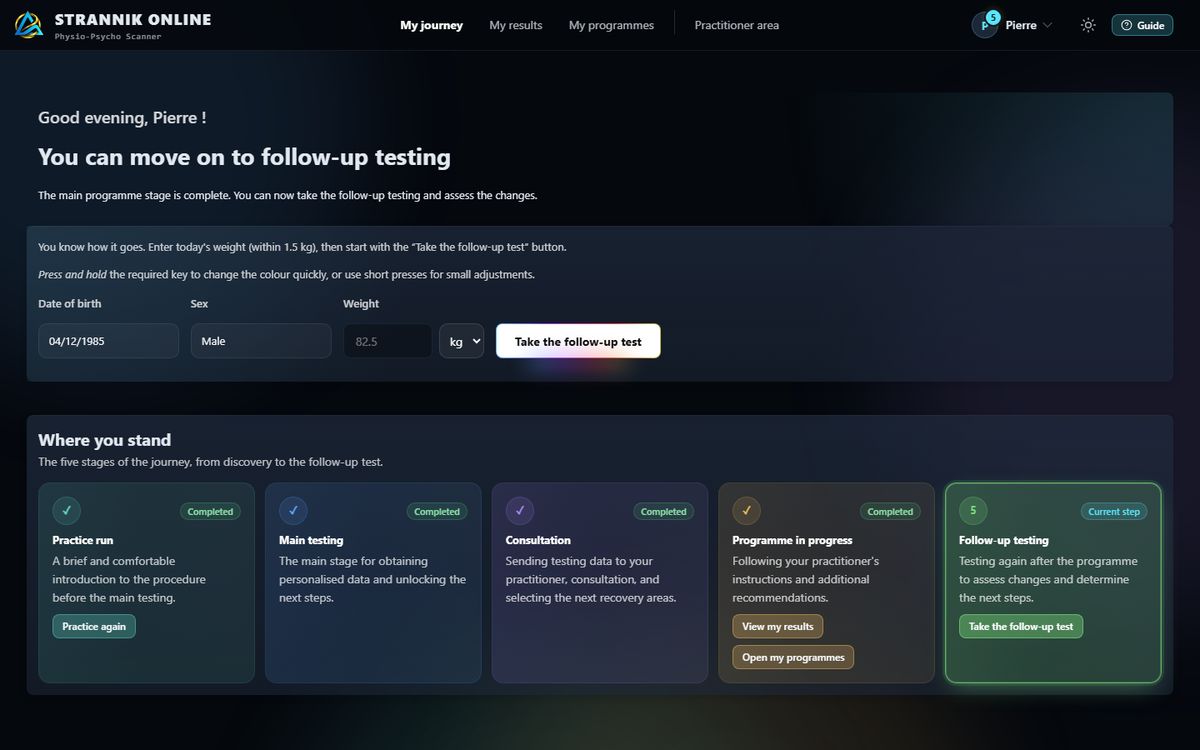 02 · The client's path
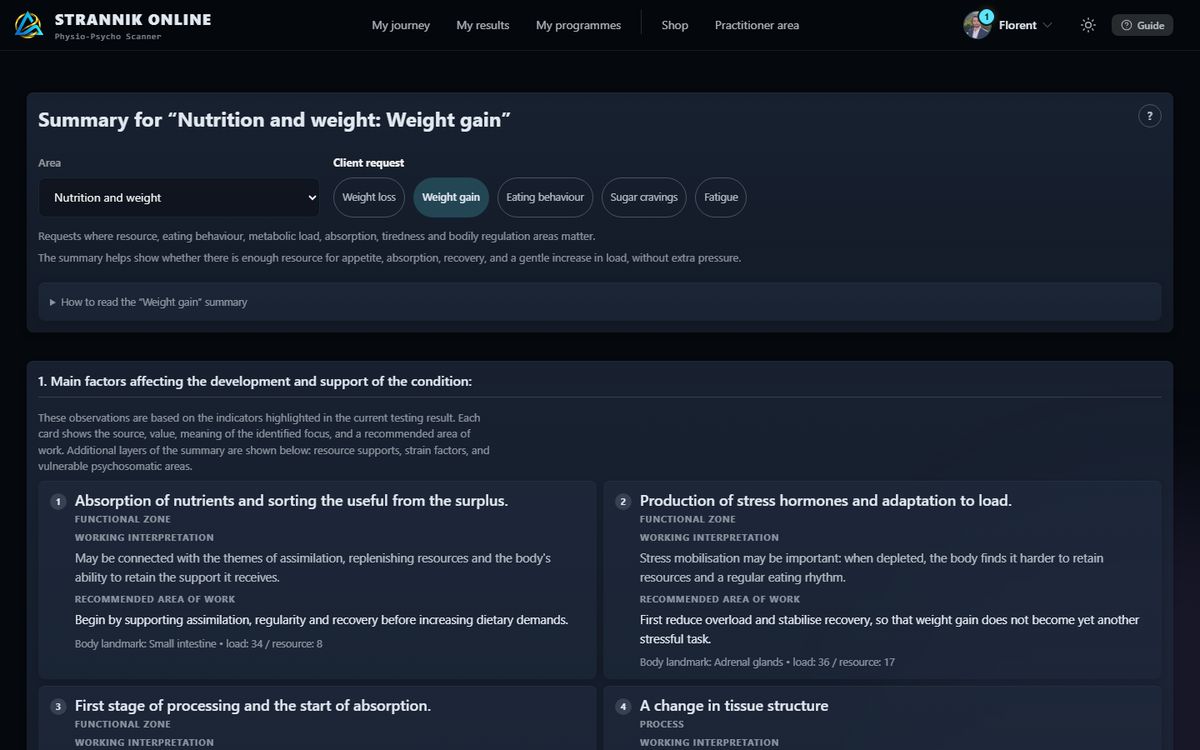 03 · The expert synthesis